
German Drinks
German Culture

German Food


Below is some information on drinks that Germans drink.  Some are not avaliable in the states and others are.  Some you may want to bring back and enjoy at home, others might just be a one-time-while-in-Germany thing.  Also I’ve listed some beer and beer information, like the German Purity Law.

Note:  When you are at a resturant and two sizes are listed for drinks, Germans tend to assume that you want the larger one unless you specifically ask for the smaller size.
Hefeweizen
Berliner Weisse
Pils
Augustiner Edelstoff
The Purity Law
Apfelsaftschorle
Spetzi
Mineral Water
Beer
Radler
Mineral Water

Even though Germany’s tap water is perfectly fine for drinking, Germans prefer to drink mineral water.  The most common is anything with carbonation.  Since Germans don’t add ice to their sodas or to their drinks they also do not drink their water cold.  The carbonation gives the feeling of cooler water.  The only down-side is that you can’t drink a lot all at once without hurting your stomach.  Germans also understand that most Americans do not drink fizzy water and they will often ask if you want it with or without bubbles.


Apfelsaftschorle or Apfelschorle

Apfelsaftschorle is a must for everyone traveling to Germany.  Maybe because Germany has a lot of old apple orchards or apple juice is really cheap, Apfelschorle is the most common non-alcoholic drink that I see around here.  It is quite simple to try yourself, just mix one part 100% apple juice with one part bubbly water (or more water if you don’t like to drink too much juice).  This is also considered to be the healthiest sports drink in Germany.  Germans don’t like to drink 100% juice and will mix most of their juices while at home. 
Spezi

This mix of orange soda, cola, and lemon juice is most common in Munich and Bavaria.  Coca-cola has one version, Mezzo Mix that is good and found pretty much everywhere.  You can make it at home with one part orange Fanta and one part cola.
Beer

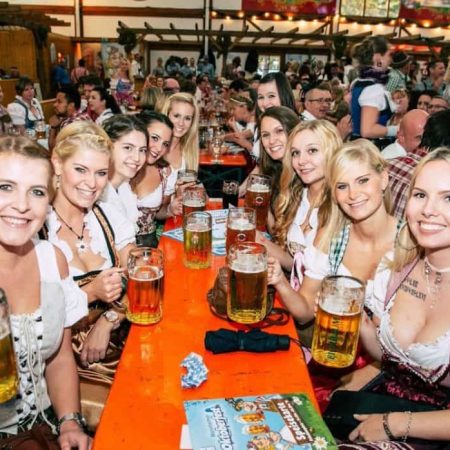
In general beer is served by the half liter or by the liter.  A full liter of beer is call a maß (not like a church mass, but a m-ah-ss).  When you go into a beer hall or a beer tent most people order their beer by the maß.  During Oktoberfest some people will sit in a tent all day and drink 3-5 maß.  How they do it, I don’t know.
Radler

In the summer time or after sports or skiing many Germans enjoy a drink called a Radler (translation: a biker).  It is a mixture of half Sprite or Lemonade and beer.  It is very refreshing and good for people who can’t drink a whole maß of beer. 


Hefeweizen or Hefe (called Weißbier in Bavaria)

This is the German wheat beer which is very common in southern Germany.  Sanwald makes a good Hefe.  This is basically beer that was made without filtering out the yeast which is what makes it cloudy.  Usually you do not order a whole maß of Hefe as it is pretty heavy beer.  But people do order 2 half liters.  This beer is not good to drink out of the bottle; you have to drink it from a glass.
Berliner Weisse

If you stop in Berlin you have to have a Berliner Weisse.  This beer is not common outside of Berlin.  It is a wheat beer that is quite weak for German beers (only 2.8% alcohol).  Since it is very sour plain it is often drunk with raspberry or green woodruff sauce.  It is then called a Berliner Weiss mit Schuss.  It is good to have in the summer and is served in a large glass with a straw.
Pils or Pilsner

This is a pale lager and a very common type of beer in Germany.  This is what most women order when they go out (hefeweizen is seen as too heavy for women).
Augustiner Edelstoff

This is my favorite beer of all.  It isn’t easy to find in Stuttgart, but I would assume you can get it in Munich because that is where it is brewed.  The Augustiner brewery was founded in 1328 by a group of monks.  The recipe contains three things, barley, hops and water and has not changed since 1328.
The Purity Law

In 1516 the Purity Law was passed in Bavaria that allowed only barley, hop and water to be used for beer production.  This insured that no unhealthy additives where added to people’s beer and that brewers weren’t using food stuffs needed to make bread.  Yeast wasn’t mentioned because at the time people did not understand its importance in beer brewing.  Throughout the years the rest of German adopted this law and in 1906 the First German Empire was regulated by the German Beer Law which is based on the Bavarian Purity Law.  To this day breweries are regulated by beer brewing rules from the 1500’s.
Google
 
A Green Berliner Weisse